Project
Applied engineering systems
An ongoing area of notes and exploration around engineering fundamentals, modeling, optimization, process flows, constraints, and system-level technical reasoning. Current focus: building a cross-disciplinary view of optimization, from pharmacometrics to machine learning to quantum.
Context
A working area for sharpening engineering fundamentals that cut across roles: modeling, constraints, process flows, optimization, integration, and failure modes. Not a claim of expertise in any single engineering discipline; a place to think out loud about how technical concepts become practical decisions.
What I'm exploring
Right now the main thread is optimization. How the same underlying shape (an objective, some decision variables, a feasible region) shows up in pharmacokinetic parameter fitting, in machine learning loss functions, and in newer quantum formulations. Alongside that: how assumptions shape models, where constraints actually bind, what sensitivity analysis reveals, and where designs are most likely to fail.
Status and next questions
Ongoing. Notes accumulate under the Engineering systems category. Open questions are mostly about how to make engineering reasoning legible to non-engineers without flattening the parts that matter.
Optimization across disciplines
An ongoing personal effort to build a unified view of optimization. I came in through pharmacometric model fitting, picked up the machine learning vocabulary along the way, and am now reading into quantum formulations. The point is not to master every solver, but to recognize the same shape across very different domains and notice when a problem has been framed badly before any compute is thrown at it.
Notes from ongoing self-study and project work. Not a survey paper; just where my thinking is right now. References below for the quantum side, where I am the least experienced.
The common shape
Strip the vocabulary away and most optimization problems look the same: minimize an objective function f(x) over decision variables x, subject to constraints g(x) ≤ 0 and x in some feasible set. The interesting work is almost never in the solver. It is in choosing f honestly (does it actually capture what you care about?), naming the constraints (which ones are hard physics, which are policy, which are wishful thinking?), and checking whether the answer is sensitive to either choice. Once those are right, plenty of off-the-shelf solvers will close the loop.
Pharmacometrics and PBPK
This is where I started. Fitting a physiologically-based pharmacokinetic model to in vivo biodistribution data is an optimization problem: the decision variables are the unknown model parameters (clearances, partition coefficients, uptake rates), the objective is typically a sum of squared residuals between log-transformed predicted and observed tissue concentrations, and the constraints come from physiology (non-negative concentrations, mass balance across compartments, parameter ranges that make biological sense). Sensitivity analysis is how you ask which decision variables actually move the objective; the ones that do not are not worth the experimental effort to estimate precisely.
Machine learning
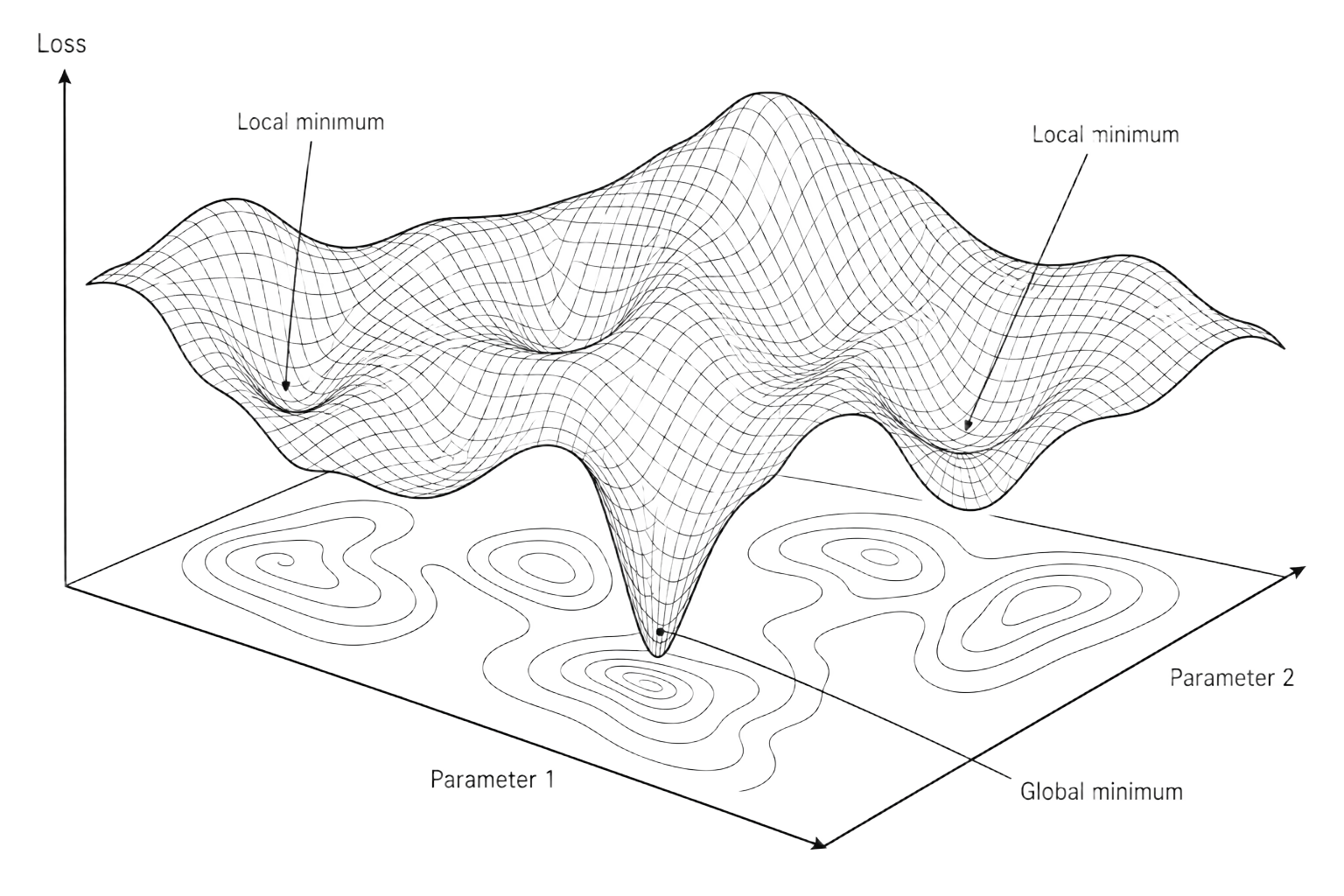
Same shape, different words. The loss function L(θ) is the objective, model parameters θ are the decision variables, regularization terms are soft constraints that penalize undesirable regions of parameter space. The workhorse update is gradient descent: θ ← θ − η ∇L(θ), with η as the step size. What changes from PBPK fitting is scale (millions to billions of parameters instead of dozens), non-convexity (many local minima, and the loss surface matters as much as the minimum), and a more subtle problem: the loss you can compute is usually a proxy for what you actually care about. Cross-entropy is not accuracy; accuracy is not calibration; calibration is not fairness. A lot of practical ML work is really arguing about which objective to write down.
Quantum optimization (learning in progress)
The piece I am newest to. The angle that interests me is QUBO (quadratic unconstrained binary optimization) and Ising-model formulations [1], where a wide class of combinatorial problems (scheduling, routing, graph partitioning, even some forms of model selection) can be rewritten as minimizing x^T Q x over binary x, and then handed to a quantum annealer or a variational quantum algorithm. I am reading more than building here, and the question I keep coming back to is honest: where is the speedup actually real on hardware available today, versus where is the framing just a rephrasing of a problem that classical heuristics already solve well enough?
What carries across
The most transferable skill is not knowing a particular solver. It is recognizing when a problem has been framed as the wrong optimization: a proxy objective standing in for the real one, a missing constraint that lets the solver exploit something it shouldn't, a feasible region drawn too tightly or too loosely. Most of the leverage in any of these domains comes from rewriting the problem before solving it, not from solving the original problem better. The picture that ties it all together is the loss landscape itself: a surface over the decision variables, with basins where the objective is low. Every method above is some strategy for navigating that surface without getting stuck in the wrong basin.
References
- [1]Lucas A. Ising formulations of many NP problems. Frontiers in Physics 2:5 (2014). link