Note · Jun 2026
n8n vs. Claude Code (and other AI agents) for automation
Coding agents build automation fast. Orchestration platforms run it in production.
AI coding agents such as Claude Code are genuinely impressive. In many cases, they are fast enough, and good enough, to build scripts, integrations, and even early automation logic from plain-English instructions.
But the deeper question is not whether Claude Code can automate things. It can.
The more important question is whether it provides the right operating model for production automation, especially when an automation must be understood, monitored, secured, governed, and handed off across a team or an enterprise.
That is where the comparison with n8n becomes much more interesting.
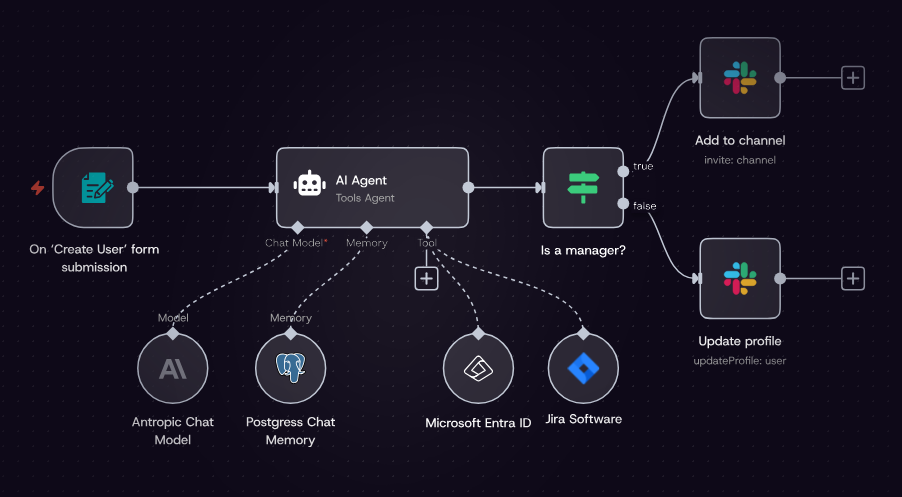
n8n and Claude Code are not direct substitutes in the strictest sense. n8n is a workflow automation platform built around explicit flows, reusable nodes, and operational control. Claude Code is an agentic coding tool that reads code, edits files, runs commands, and works across the terminal, IDE, desktop application, and browser.
One is primarily an orchestration runtime. The other is primarily an AI coding and task-execution agent.
That distinction matters when teams move from experimenting with automation to operating it across a business.
A practical thesis
When the goal is to build automation logic quickly, Claude Code and similar agents can be excellent force multipliers.
When the goal is to run, govern, observe, and scale automation across a business, n8n usually provides a stronger operational layer.
The strongest pattern is often hybrid: allow AI agents to help create and refine the automation, then run the repeatable production workflow in a system designed for orchestration and control.
At a glance
| Area | n8n | Claude Code and other AI agents |
|---|---|---|
| Primary role | Workflow automation and orchestration platform | Agentic coding and task-execution assistant |
| Visibility | Visual flow editor with explicit nodes and paths | Code, outputs, commands, and session history without a built-in workflow canvas |
| Hosting model | Can be self-hosted using Docker, Docker Compose, AWS, Azure, Google Cloud, Kubernetes, OpenShift, and other infrastructure | Available through terminal, IDE, desktop, and browser interfaces as a managed Anthropic product |
| Governance | Role-based access, projects, Git-based environments, external secrets, and workflow permissions | Managed policy settings, tool permissions, file restrictions, usage analytics, and a Compliance API |
| Best fit | Repeatable production workflows, enterprise automation, and auditability | Rapid building, prototyping, developer productivity, and custom scripts |
| Security posture | Strong infrastructure and data-residency control when self-hosted | Strong safeguards, but the model and service layer remain vendor-managed |
The clearest divide is that n8n is built to operate workflows, while Claude Code is built to help people create and execute work with AI assistance.
Claude Code can absolutely participate in enterprise automation, but it usually acts as a builder or agent layer unless the organization is prepared to engineer a broader runtime and governance system around it.
Why seeing under the hood matters
One reason n8n resonates with technical teams and enterprise operators is that the workflow is visible.
You can see triggers, conditions, tools, branches, outputs, and dependencies on a canvas. The product is structured around workflows, executions, debugging, credentials, and explicit node behavior.
This makes it easier to inspect:
- What happened
- Which step failed
- What data entered and left each step
- Why a particular branch was selected
- Whether the workflow can be safely rerun
That visibility becomes valuable when a workflow fails in the middle of the night or when another employee has to maintain something that was built six months earlier.
Claude Code can show the code it writes and the actions it proposes, but it does not provide the same native, always-visible orchestration layer.
The user is generally reasoning through files, commands, prompts, logs, diffs, and session context rather than through a visual process map. That can work well for developer-owned workflows, but it creates a different maintenance experience from a system where the automation itself is represented visually.
This also affects who can work with the automation.
n8n is generally easier for mixed teams such as operations, IT, RevOps, product operations, marketing operations, and semi-technical business users. Claude Code is more naturally aligned with developers and power users.
The difference is not primarily about intelligence. It is about maintainability, handoff, operational clarity, and who can understand the system after it has been deployed.
Can Claude Code do enterprise-wide automation?
Yes, in part, but not in the same way n8n can.
Anthropic offers Claude Code through Team and Enterprise plans with features such as:
- Centralized seat management
- Spending controls
- Usage analytics
- Managed policy settings
- Tool permissions
- File-access restrictions
- MCP server controls
- Compliance and auditing capabilities
These are meaningful enterprise features, and they demonstrate that Claude Code can be deployed across large organizations.
What it does not provide, out of the box, is the workflow-orchestration layer that n8n is built around:
- Centralized workflow history
- Explicit retry paths
- Credential-sharing models
- Queue-based scaling
- Workflow-level approval steps
- Visual environment promotion
- Reusable workflow components for business users
Therefore, when someone says that Claude Code can perform enterprise automation, the most accurate response is:
Claude Code can be enterprise-capable without being enterprise-orchestration-complete.
Security and hosting: where the differences become clearer
1. Data residency and hosting control
n8n can be self-hosted across many environments. Organizations can deploy it using:
- Docker
- Docker Compose
- AWS
- Microsoft Azure
- Google Cloud
- Kubernetes
- OpenShift
- Virtual machines
- Private internal infrastructure
For organizations operating in healthcare, finance, government, legal services, or other regulated environments, this deployment flexibility may be one of n8n’s most important advantages.
Self-hosting can support requirements involving:
- Data residency
- Private network access
- Internal databases
- Restricted APIs
- Custom retention policies
- Internal logging
- Enterprise identity providers
- Security monitoring
- Disaster recovery
Claude Code is different.
It is available through Anthropic’s terminal, IDE, desktop, and browser interfaces. The client may operate on a local machine and work inside a private repository, but the underlying model and service layer remain part of Anthropic’s managed offering.
Claude Code should therefore be viewed as a managed AI product rather than a fully self-hosted automation runtime.
2. Governance, access, and change management
n8n’s enterprise tier includes operational controls such as:
- SAML
- OIDC
- External secret stores
- Git-based source control
- Development and production environments
- Workflow history
- Log streaming
- Security settings
Git-based environments are especially useful for enterprise automation because they allow workflows to move through controlled stages.
A team can build and test a workflow in development, review the changes, and then promote it into production. This creates a more formal change-management process than editing a live production automation directly.
| Security or operational issue | n8n | Claude Code and other AI agents |
|---|---|---|
| Self-hosting | Broad self-hosting and infrastructure options | No equivalent self-hosted orchestration platform in the official product model |
| Data residency | Organization can control where the application and execution data are hosted | Depends on the managed Claude service and the Claude enterprise agreement |
| Secrets management | Built-in credential management with external secret store support | Depends on enterprise configuration and the surrounding tooling |
| Access control | Roles, projects, workflow permissions, credential access, and SSO-related features | Seat management, policy settings, tool permissions, and file-access restrictions |
| Change management | Git-based environments and explicit promotion paths | Code review and repository conventions, but no native workflow promotion model |
| Prompt-injection surface | Limited to nodes that explicitly call an LLM and pass untrusted content | A central security consideration when an agent interprets untrusted content |
| Operational handoff | Visual workflows can be reviewed by technical and semi-technical users | Usually requires familiarity with code, repositories, prompts, and developer tools |
Where each tool fits best
Use n8n when the automation must:
- Run from schedules, webhooks, forms, or system events
- Move structured data reliably between systems
- Be monitored by operations or IT teams
- Support approvals or deterministic branching
- Share credentials safely across workflows
- Maintain an execution history
- Be managed outside a single developer’s workstation
- Satisfy self-hosting or data-residency requirements
Use Claude Code when the work is primarily about:
- Writing or refactoring code
- Prototyping a new integration
- Generating transformation logic, scripts, or one-off utilities
- Accelerating developer productivity
- Producing the code that an orchestration platform will later run
A practical pattern might look like this:
- Claude Code helps design the automation.
- It generates integration code or custom transformation logic.
- The developer reviews and tests that code.
- n8n triggers and orchestrates the production workflow.
- n8n handles scheduling, credentials, branching, retries, and execution history.
- Claude or another model is called only for the portions that genuinely require judgment or language reasoning.
This allows deterministic steps to remain deterministic while reserving AI for the parts of the process that actually benefit from it.
Bottom line
The strongest argument for n8n is not simply that it can automate work.
It is that n8n lets an organization see, govern, and operate automation in a way that is often better suited for production and enterprise environments.
The strongest argument for Claude Code is not that it replaces workflow platforms.
It is that it can dramatically accelerate the work of building, scripting, and extending automation, especially when paired with a platform like n8n that handles the runtime, governance, and operational realities of running automation at scale.